South Asia has expanded formal school enrollment at an unprecedented rate. Yet, the region still carries one of the world’s largest concentrations of out-of-school adolescents and low-literate adults. Governments have built infrastructure and increased teacher recruitment, but structural exclusion persists. Rural poverty, seasonal migration, ecological vulnerability, and weak institutional integration continue to prevent millions from completing basic education. Non-formal education emerged not as a temporary supplement but as a structural response to this systemic failure. The central policy question is no longer whether non-formal education is necessary. It is whether governments are prepared to integrate it into national development architecture rather than allowing it to function as a parallel track with limited mobility.
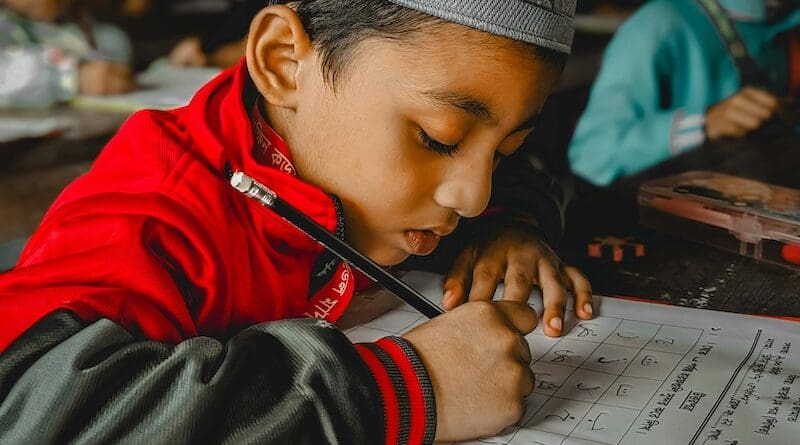
Across South Asia, non-formal education models target adolescents who missed the official age of enrollment, adults who never entered school, and children who dropped out early. These programs typically operate through community learning centers, adapt schedules to agricultural cycles, and combine literacy with health awareness, civic instruction, and livelihood skills. The approach recognizes a basic reality. In low-income rural settings, education must align with economic survival if it is to be sustained.
Bangladesh illustrates both the promise and the limits of this model. The country has achieved strong gains in primary enrollment and gender parity. Yet rural disparities remain pronounced. Ecologically fragile regions such as haors and chars experience seasonal flooding that disrupts schooling. Remote communities face shortages of government primary schools, while overcrowded classrooms and teacher constraints affect quality. Poverty continues to push children into early labor. These conditions sustain dropout flows and perpetuate educational discontinuity.
In response, Bangladesh adopted the Non-Formal Education Policy in 2006 as the principal framework governing the sector. The policy set ambitious targets, including a substantial reduction in adult illiteracy and the gradual establishment of a lifelong learning culture. It aimed to reach citizens between the ages of eight and forty-five who had either never enrolled or had discontinued schooling. It prioritized ethnic minorities, street children, and residents of geographically isolated areas. It linked literacy to income generation through vocational and entrepreneurship training and proposed decentralized, community-based delivery mechanisms.
The Bureau of Non-Formal Education under the Ministry of Primary and Mass Education coordinates implementation. Through initiatives such as the Integrated Non-Formal Education Program, it oversees thousands of learning centers nationwide. The standardized Chetona primers introduce learners to social rights, public health, disaster preparedness, and environmental awareness. The system also provides training in approximately twenty trades,
including poultry rearing, nursery management, embroidery, plumbing, and motor mechanics. More than seven hundred nongovernmental organizations participate in delivery, making non-formal education one of the largest public-private collaborations in Bangladesh’s education sector.
However, scale has not resolved structural weaknesses. Bangladesh still lacks a fully operational Non-Formal Education Management Information System. Without reliable data on enrollment, retention, completion, and transition outcomes, policymakers cannot evaluate performance accurately. Planning, therefore, relies on fragmented reporting rather than systematic evidence.
The absence of an equivalency framework presents a more serious constraint. Most technical and vocational institutions require a Grade Eight certificate for admission. Non-formal learners typically achieve competencies equivalent to primary levels. The system does not formally recognize their learning against national standards. As a result, many learners acquire foundational literacy but cannot progress into higher skill pathways. This institutional barrier undermines the poverty reduction objectives embedded in the policy.
Socioeconomic pressures compound these challenges. A large proportion of the population lives close to or below the poverty threshold. Families struggle with indirect costs such as transportation, materials, and the opportunity cost of child labor. Rural infrastructure remains uneven, and digital access varies significantly. Under these conditions, non-formal education cannot rely on flexibility alone. It requires structural alignment with labor markets and formal accreditation systems.
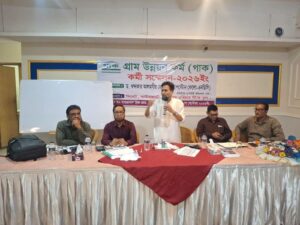
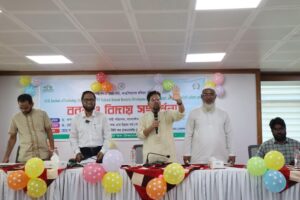
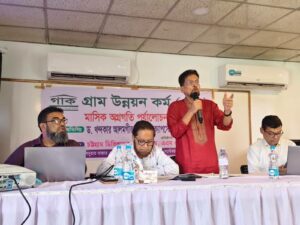
Within this national landscape, Gram Unnayan Karma demonstrates how community based non formal education can operate at scale in northern Bangladesh, where poverty rates remain among the highest in the country. Districts in the north face seasonal unemployment, limited industrial diversification, and recurring climatic stress. These pressures intensify educational vulnerability and increase dropout risk.
After conducting a feasibility assessment in the Bogra district, GUK launched the Shishu Bikash Education Program in 2016 and expanded full operations in 2017. The initiative now operates 1465 Non-Formal Primary Education schools serving approximately 45500 students, supported by 1465 teachers and 130 staff members. These figures reflect organized coverage rather than isolated intervention. By situating learning centers within villages, the program reduces travel barriers and indirect costs. Its cost-sharing approach strengthens community participation while maintaining affordability for low-income households.
The GUK experience confirms that non-formal education can re-engage dropout children and expand access even in high-poverty regions. It also exposes the limits of localized success. Without nationally recognized transition pathways, graduates of such programs face restricted progression into secondary or vocational streams. Community-scale delivery cannot compensate for national-level accreditation gaps.
Bangladesh now stands at a policy crossroads. It has built a wide non-formal education network and mobilized extensive civil society participation. Yet it has not fully integrated this sector into the mainstream education and skills ecosystem. Establishing a comprehensive management information system, developing a formal equivalency framework, restoring expert advisory capacity within the sector, and aligning non-formal training with market demand are no longer optional reforms. They are prerequisites for transforming access into mobility.
South Asia’s broader development trajectory depends on whether governments treat non-formal education as a residual safety net or as a core pillar of human capital strategy. Bangladesh has demonstrated operational capacity through policy commitment and large-scale partnerships. The next step requires institutional integration. Without it, non-formal education will continue to expand literacy while limiting advancement. With it, the sector can function as a credible pathway from rural marginalization to economic participation.
Article courtesy: https://www.eurasiareview.com/23022026-non-formal-education-and-rural-development-in-south-asia-with-lessons-from-bangladesh-oped/